Meet Charles Wooldridge | Fine Artist of multiple disciplines.


We had the good fortune of connecting with Charles Wooldridge and we’ve shared our conversation below.
Hi Charles, what was your thought process behind starting your own business?
That we should all live in artful environments and that art is relative at so many levels. The most critical being; heart felt decision making. This is where I have created “BANG”, and interactive art piece that initiates the ability to forgo such limited social constructs as winning or losing, pretty or ugly promoting the individual to a stage of being a creative able to solve issues that are typically boxed and set on the self. Many phycologists and therapist have used these art pieces to illustrate the importance of overcoming trauma. Just as important is, that it opens pathways to all thought processes of life in general. Quite often I will initiate a conversation with clients by playing this art piece to help them understand process and outcome of developing artwork for interior and exterior applications.

Let’s talk shop? Tell us more about your career, what can you share with our community?
Although I have been represented in galleries from NYC, Chicago, Atlanta, Denver Northern and Southern Californian won many local and national awards, I have never regarded art as decoration or something considered art by most peoples idea. For me, art has always been a higher form of aesthetic thought — a way to develop concepts, model ideas, and challenge the way we perceive reality. My reinvention of chalk pastels began with the pursuit of a perfectly flat surface of unparalleled color and expression, a surface designed not for display but for interaction between the frontal lobe and cerebral cortex. This departure from commercial mediums led to challenges in New York exhibitions, and ultimately to a five-page feature in Pastel Journal clarifying my approach.
My sculptures emerged from this same pursuit of interaction and amalgamation. Working in steel, stone, and wood, I developed the series To Cause to Happen, where form, material, and the mechanisms of attachment held equal value. My work was recognized internationally, including reviews in the Museum of Contemporary Art in Prague by Jan Kříž, Ph.D., art historian and critic, AICA. Out of these explorations, I conceived Cusp Theory: the idea that everything exists at the point of confluence, where forms and forces compress and recombine infinitely. To model this, I began counting and categorizing cars at intersections — using data as a metaphorical and visual tool. This theory grew into public sculptures across Denver and collaborations with architects such as Kurt Fentress, as well as keynote lectures at the International Arts and Math Conference, where I witnessed others applying my models to fields from consumption analysis to genome research.
These ideas converged in my work with the Denver Street School, where I invited students into my studio and encouraged them to create “Ugly Art.” By reframing their work as containing beautiful areas, I challenged their learned constructs of good, bad, beautiful, and ugly. Over time, they broke free from those boundaries and became what I call True Creatives. From this, I developed the concept of Our Aesthetic Core, a framework built on Chance, Choice, and Aesthetics. Within it, two dimensional ideas resolve into three dimensional, perfect fractals, opposites dissolve, and participants are left to make heartfelt decisions that always resolve into beauty.
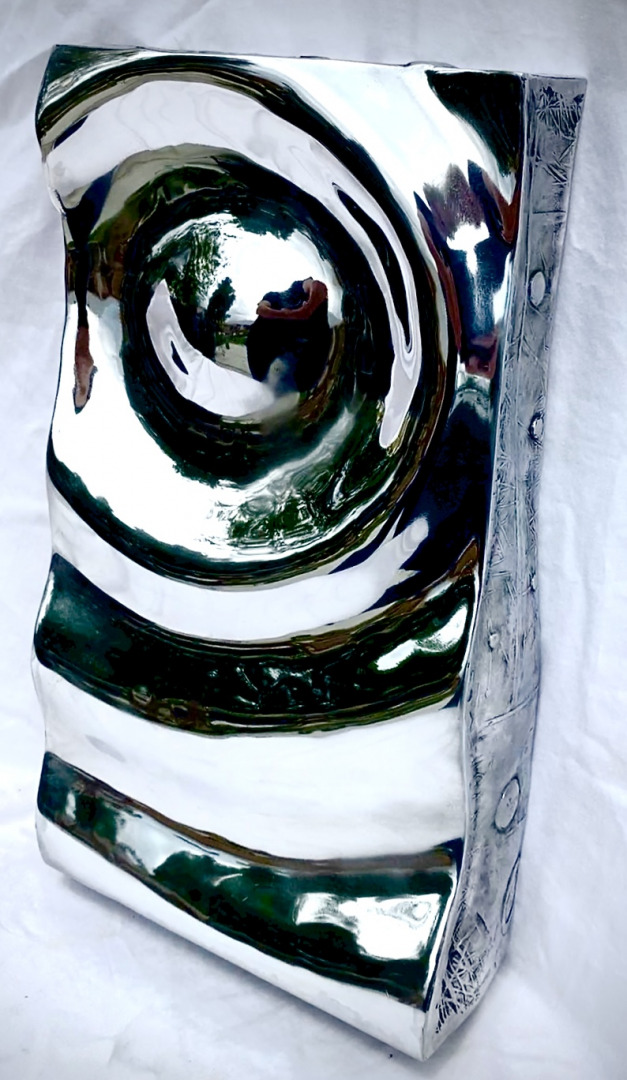
In recent years, my architectural projects — massive fireplaces, entries, and doors — have become physical manifestations of these philosophies, treating the home as a point of confluence for people and art. Today, I am exploring what I call The Point of Origin, combining all mediums into jewelry-like sculptures of hand-hammered aluminum, acid-etched cryptic notations, and the accumulated scars of forty years of recorded experimentation on my work table.
At every stage, my work seeks to dissolve boundaries — between thought and form, beauty and ugliness, chance and choice — to reveal art not as decoration, but as a language of connection, confluence, and authenticity.
Any places to eat or things to do that you can share with our readers? If they have a friend visiting town, what are some spots they could take them to?
If it happened to be a First Friday, we would definitely hit the Santa Fe art district and eat Chile Riano burritos at Taco de Mexico or El Noa Noa for for steak burritos and margaritas. There is a wide range of galleries that run from 3rd all the way ups to 13th. My favorite gallery is Space gallery at 4th and Spark Co-op at about 9th.
Other nights its to Broadway from The Wizards Chess, music at the 404 to Denver Distillery. Then there is the North end where I lived for 20 years what was called LODO but is now called RINO.
The train station is also one of my favorites with the Robischon Gallery close by.
As far as museums are concern, the Vance Kirkland museum is my favorite hideout.

Shoutout is all about shouting out others who you feel deserve additional recognition and exposure. Who would you like to shoutout?
Growing up, I moved nine times in twelve years. Along the way, I was blessed in sixth grade to have a drafting teacher who recognized my ability to conceptualize abstract ideas on paper. That gift freed me to start inventing things.
By some strange fate, in 1976 we moved back to Denver, where I was born, and I enrolled at Denver Academy. There, I met two extraordinary teachers, Steve Tattum and Jim Loan. They were completely embracing and gave me the confidence I needed to navigate academia. Being severely dyslexic made school a difficult journey, but I was thankful to God for blessing me with such caring mentors.
They saw what my drafting teacher had seen: an abstract thinker with a unique visual, mental, and philosophical approach to life. They helped me realize that building models of larger ideas was my true form of communication. If I could draw it and define it, I could make it—and in doing so, I could bridge the gap between abstract thought and physical reality, sharing ideas with others in a tangible way.
At the top of this list of influences is my father, whom I only knew for a short while. He taught me that I could fix anything, break a wild horse, and ride bulls—by the age of eleven. From him I learned to conquer fears that might hold me back from becoming who I was meant to be. And perhaps the greatest lesson of all: authenticity is the most important component of becoming a successful artist.
Website: https://www.wooldridgestudio.com
Instagram: wooldridgestudio
Facebook: Charles Wooldridge
Youtube: YouTube: Cusp Theory Charles Wooldridge


Image Credits
Charles Wooldridge